Renewables are booming but our electricity bills are still rising
Ever since renewables started making to headlines, we have expected electricity to become more abundant and cheaper. In the last decade, although progress in renewables has been impressive but we still have not seen a meaningful decrease in our bills.


Bringing the electricity cost down requires more than just producing more renewable energy. Even though the country has renewables contributing to the grid, the amount is never enough. Sadly, we still have to rely on gas-fired powered plants to step in and cover a part of our demand.
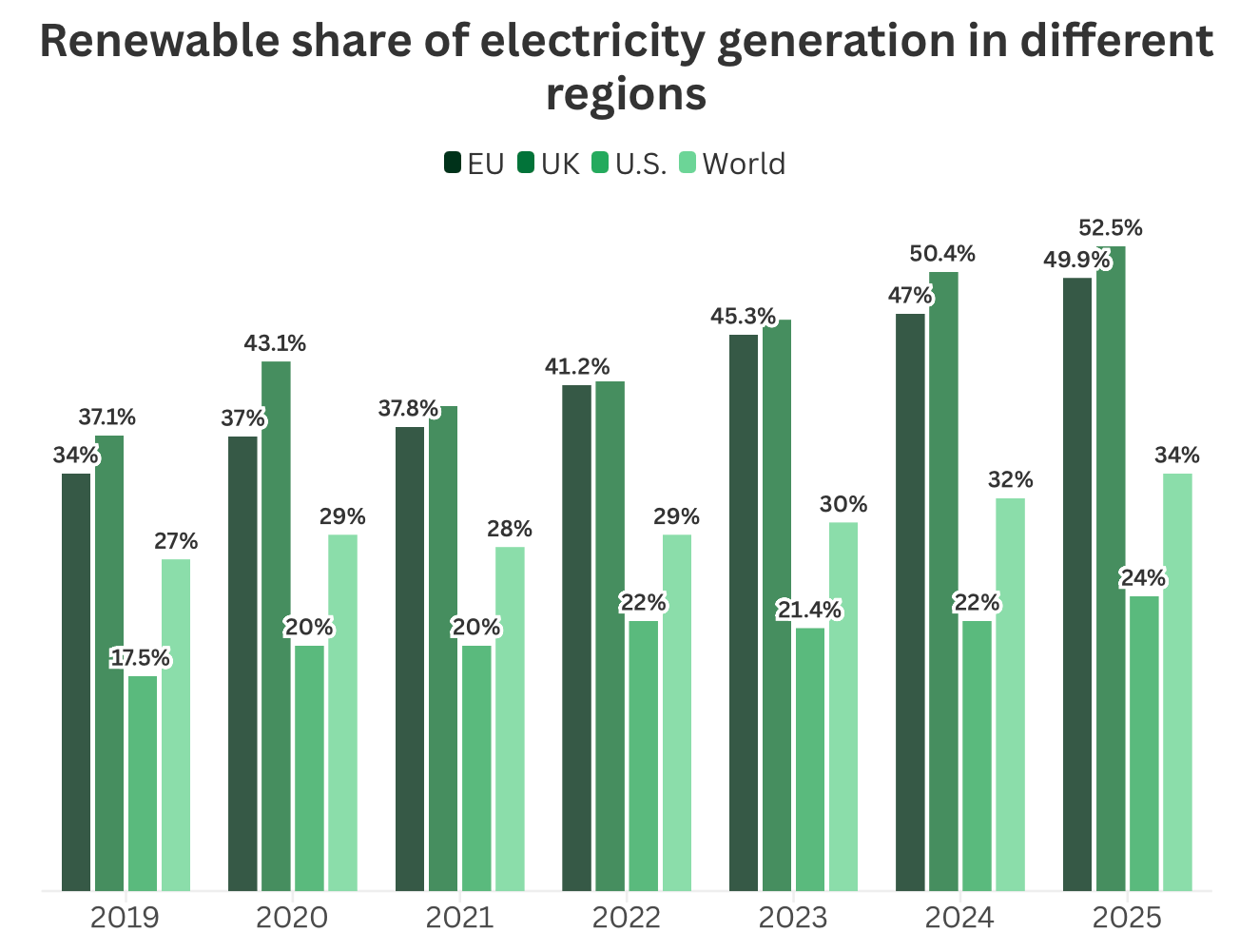
In almost every region around the world, public support for renewables, as well as their share in the electricity mix is increasing every year. It’s slow but steady (Figure 1). However, this progress is not yet reflected in our bills.
Read: Why electricity bills will keep rising even as energy gets cheaper
The hidden complication of grid balancing
In one of my previous posts, I mentioned that ageing grids is one of the main reasons behind this rising cost because they are expensive to maintain and operate.
Figure 2 shows that electricity generation (wholesale cost) just accounts for about 29% of total bill we pay. There are several other factors that come into play. And in this post, I wanted to take a closer look at balancing cost, which is about 4.8% of the bill shown in the figure.

When there is too much renewables generated and the grids become constraint, which is usually the case, the grid operators pay the renewables producers to reduce or completely stop generation. This happens when our grids are not capable of transporting all the electricity to where it is needed.
On the other hand, when we do not have enough renewables generated, the system operators has no choice but to turn to options that are often expensive. These include activating backup fossil fuel plants, and paying generators to adjust output rapidly.
This is called grid balancing and in both of these scenarios, the consumers have to bear the effect of increased cost. They may find that even though they are using more renewable energy, their bill either goes up or doesn’t go down from the previous months.
While renewable energy may become cheaper to produce but it becomes more expensive at the point of delivery.
Read: Energy security concerns lead to more coal production
Grid balancing costs and projection
When renewables were still in their early stages a few decades ago, their costs were mostly driven by hardware, such as panels and turbines. Now, enough research and experiment has made the hardware cheaper every year but what hasn’t become cheaper is the connection between the hardware and the grid.
When we have to deal with costs associated with balancing and others grid-related expenses, this only diverts investment away from the new renewable projects. Across much of the U.S. and Europe, the cost of new projects, including both solar and wind has been climbing rather than falling for the past two years. In the U.S., the electricity rates have increased 33% since 2019.
A new study by the consulting firm National Economic Research Associates, finds that continuing to constrain deployment of new solar and wind projects could add USD 11.6 billion annually to household energy bills from 2027 through 2033.
In the UK, similar prediction has been made. NESO has recently published costs for grid balancing in 2025/26 and has predicted that transmission costs are set to rise further beyond 2030.
More than £89 billion is expected to be spent on the grid over this period and this will only push electricity prices higher, which means higher bills for consumers and businesses.
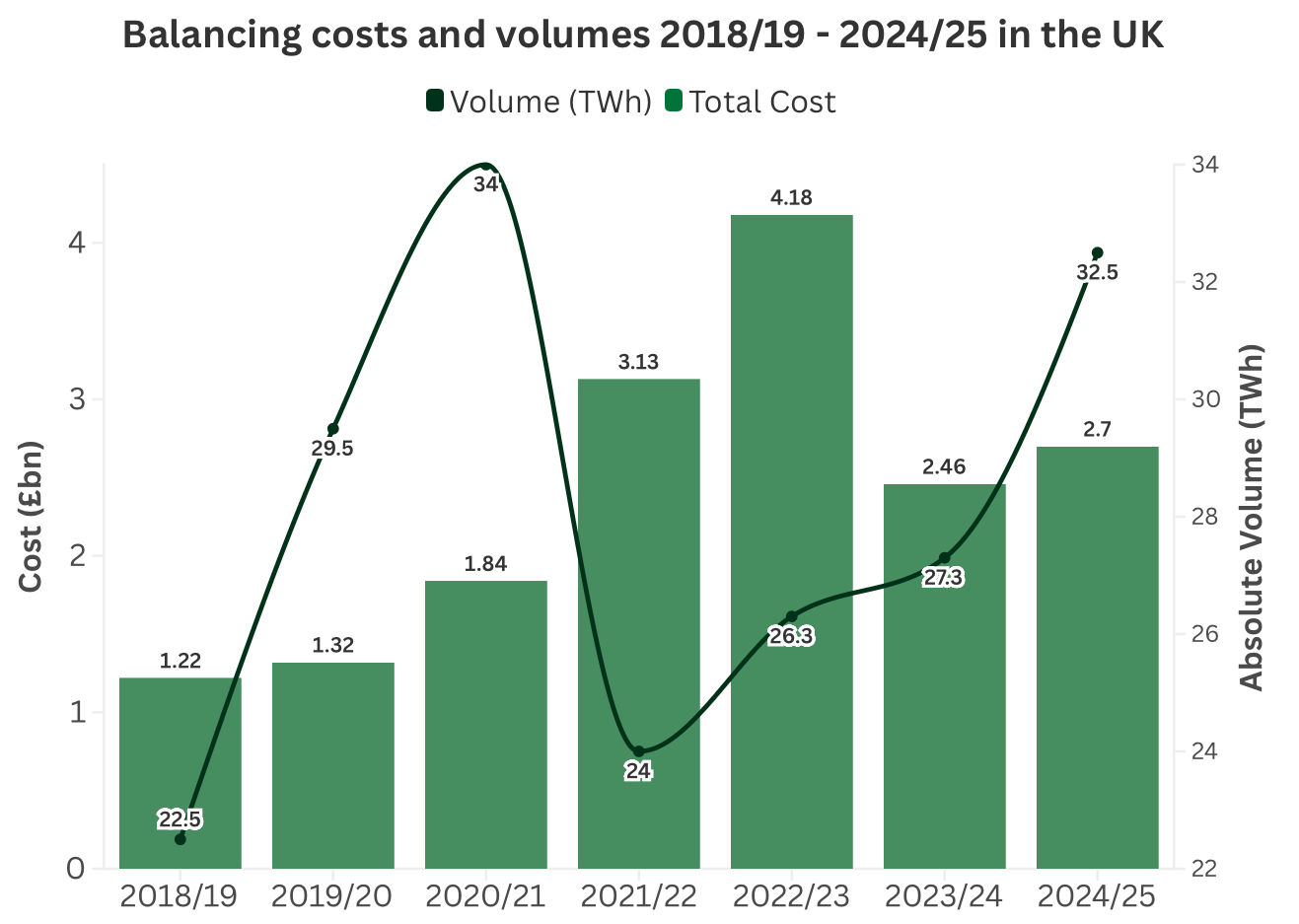
One interesting observation from Figure 3 is that, even though NESO was balancing less electricity in 2021/22, the cost was still higher. This was actually more of the price problem than the volume. Late 2021 though 2022 saw wholesale natural gas prices increase dramatically, largely amplified by Russia’s invasion of Ukraine.
Although the cost came down slightly after 2022/23, NESO still unfortunately predicts the cost of grid balancing is set to increase to £6.4-£8.3 billion by 2030. We can therefore expect this component of the price cap to continue rising over the coming years.
And what it means for business leaders
A paper in 2023 studied the short-term integration costs of wind and solar power in Britain and Germany, focusing on balancing and curtailment expenses. It found that wind generation correlates with higher balancing costs than solar, purely coming from the fact that they are located far from the electricity demand area.
Congestion management costs have risen sharply in both countries as renewable capacity expanded, and the grid bottlenecks are the main reason. When it comes to curtailment, offshore wind farms have very low annual curtailment rates, up to 0.63%. Due to their location, they are usually chosen as a last resort to be curtailed.
Read: Disadvantages of renewable energy
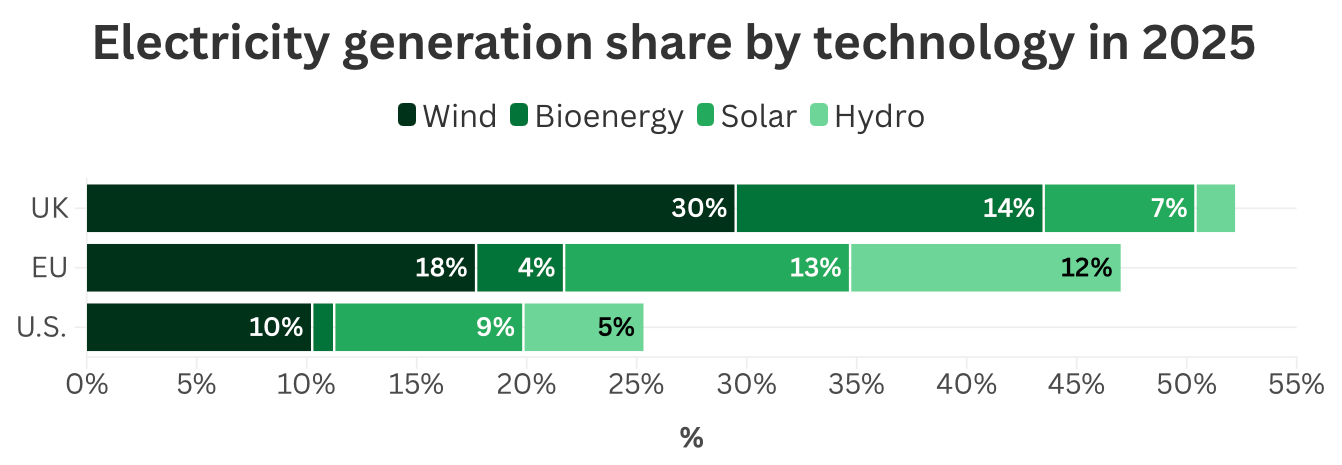
Figure 4 shows the renewables’ contribution to electricity generation by technology in the UK, U.S. and EU. The UK has a higher share of contribution from wind, which suggests that the country may also face higher cost contribution from balancing and curtailment.
This brings us to another thought. Renewables have always been advertised as a cheaper alternative. But if we are paying higher electricity bills even as the share of renewables increases, this probably means our system is not ready for them. System in this case is our grid.
The technology is getting cheaper but there are other factors that contributes to the overall cost. For example, the grid, financing, supply chains and the policy. They all contribute and they have only become more expensive every year.
Read: Could wind and solar farms coexist with agriculture?
So, if you are a business leader with a power purchase agreement (PPA), carrying out a proper risk assessment is actually more important than focusing on the headline price. For example, understanding the project's location, grid connection, curtailment risk, and how these risks are reflected in the PPA price is key.
Since some of the wind’s additional system costs come specifically from remote siting, a slightly less windy site close to existing transmission capacity may outperform a windier remote location.
Businesses could also benefit from flexible contracts that allow them to shift their electricity consumption to periods when prices are often lower, and potentially reducing their electricity bills.
We cover renewable energy, climate risk, and sustainability economics. Subscribe to get new articles in your inbox.