Why leaders should pay attention to AI’s growing electricity demand
Artificial intelligence (AI) is becoming part of everyday life, with businesses across industries exploring its potential to improve performance. However, its rapid adoption is also emerging as a major driver of rising electricity demand.


AI's presence has grown far beyond what many initially imagined and is expanding at a pace that existing electricity systems are not designed to accommodate. As it’s adoption accelerates, concerns about its environmental impact have become increasingly concerning.
Critics point to the increasing energy consumption of data centres, as well as the associated growth in water use, greenhouse gas emissions, and electronic waste. These challenges have brought the sustainability implications of AI into sharp focus, raising important questions about how its continued growth can be balanced with environmental responsibility.
Read: How Artificial Intelligence is redefining careers in clean energy
While much of the discussion has focused on sustainability concerns, the more pressing issue may be AI’s growing demand for electricity. It’s increasing power requirements could influence business costs, investment decisions, and economic growth across industries.
Figure 1 presents McKinsey’s estimate of data centre demand, showing that growth is driven not only by AI-related activities but also by demand from non-AI businesses.
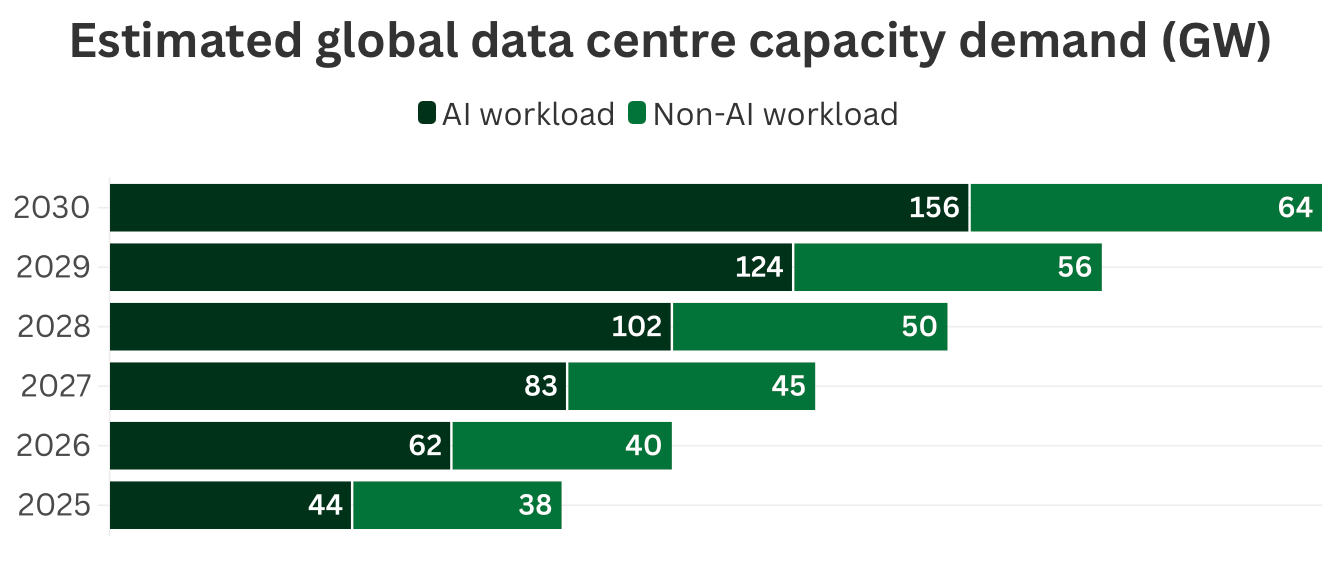
This suggests that even businesses with no intention of developing or deploying AI models may be affected by rising electricity demand. Ultimately, this brings the discussion back to a fundamental question: can current energy systems accommodate the rapid growth of AI and the increasing demand for electricity that accompanies it?
A new era of electricity demand growth
Global electricity demand is projected to grow by 3–4% annually through the late 2020s, driven primarily by three structural forces: the adoption of electric vehicles, the electrification of heating through heat pumps, and the rapid expansion of AI and the broader digital ecosystem. Although data centres are experiencing significant growth, their overall electricity consumption remains lower than that of the other major demand categories.
However, AI-related data centres represent the most unpredictable and fastest-growing source of electricity demand. The International Energy Agency (IEA) projects that global electricity consumption by data centres will increase by approximately 128% between 2024 and 2030 (Figure 2).
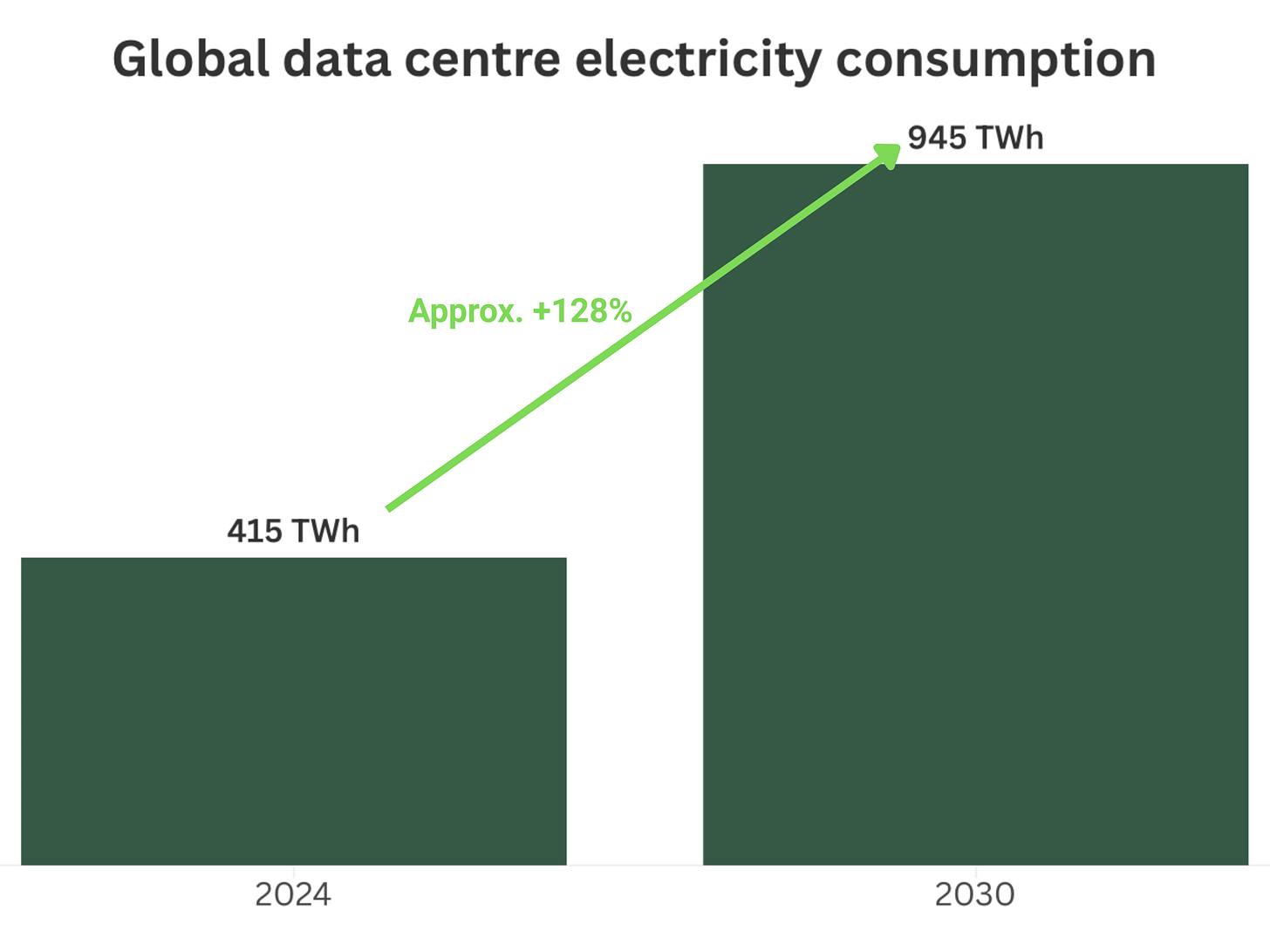
The growing demand for electricity may not be a major problem if we understand how quickly it will increase and what energy sources will be used to meet it. Although data centres currently account for a relatively small share of global electricity demand, their impact can be much greater in some countries and regions.
In areas where many data centres are being built, they can place significant pressure on local electricity networks. This makes careful energy planning increasingly important as demand continues to grow.
Some areas come under the most pressure
Nearly half of the world’s data centre capacity is located in the U.S., with a growing presence in China, Europe, and several emerging markets. However, the pressure on electricity systems is often highly localised, even within these regions.
In the U.S., data centres are expected to account for nearly half of all growth in electricity demand between now and 2030.
One of the key challenges is that electricity systems do not operate as a single global network. Instead, they are made up of separate national and regional grids that have only limited connections with one another. As a result, a rapid increase in electricity demand in one area can place significant pressure on local energy infrastructure, and this pressure cannot always be relieved by excess power from elsewhere.
What powers AI will matter enormously
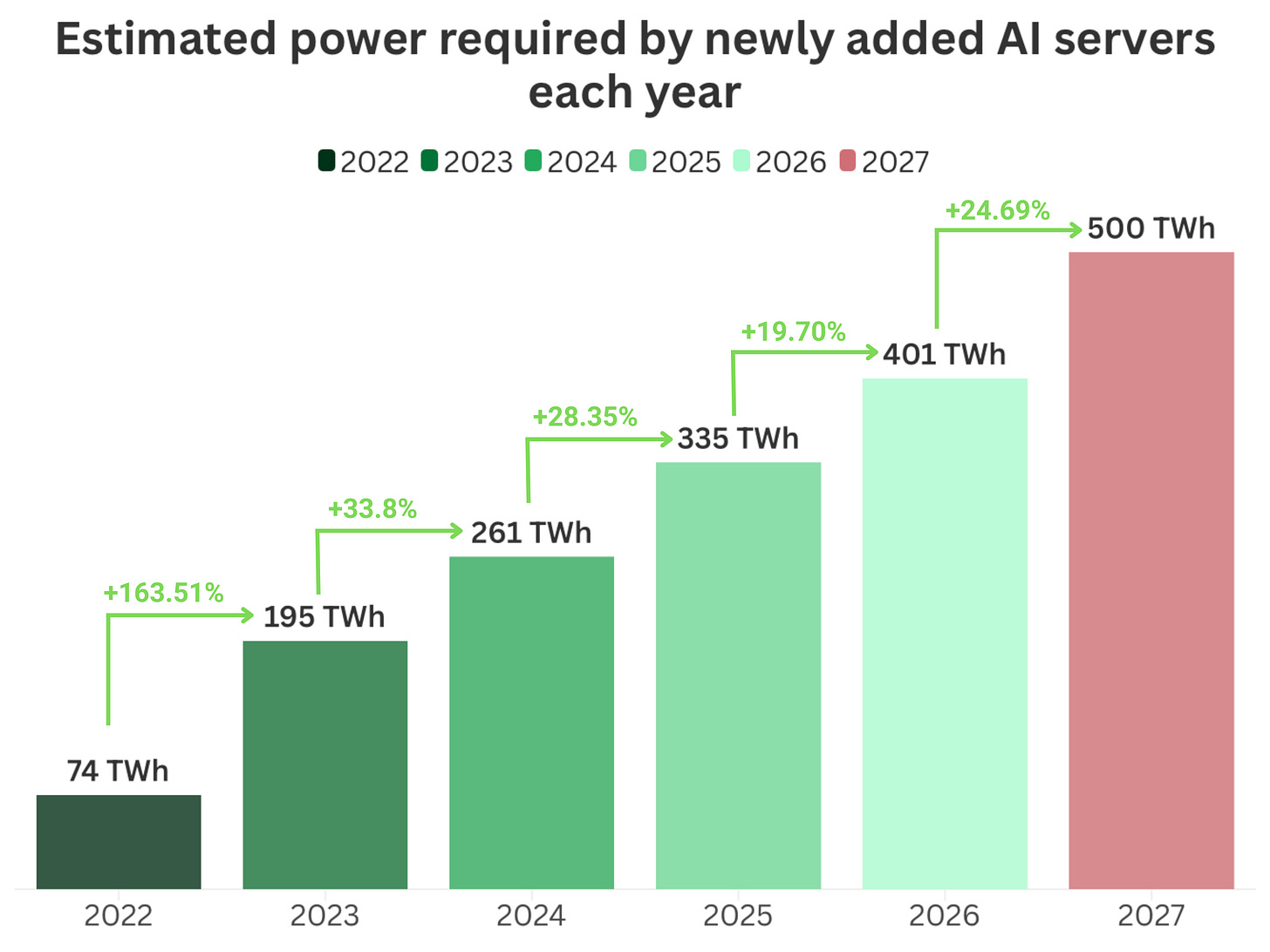
Figure 3 shows the amount of power required by newly added AI servers each year between 2022 and 2027. Currently, fossil fuels supply close to 60% of global data centre electricity, with renewables and nuclear providing the rest.
The IEA projects that by 2035, around 60% will come from clean energy sources, including solar, wind, hydro, and nuclear.
Renewables also come with their own set of challenges, as they are dependent on weather conditions. Meeting the continuous, high-intensity power demands of data centres using renewables alone requires energy storage, and current storage economics remain challenging. As a result, many data centres still rely on fossil fuel backup systems to ensure a reliable power supply.
Read: 7 disadvantages of solar energy
Read: Disadvantages of renewable energy
As demand grows, there is an expanding market for smaller and mid-sized data centre operators in shared energy purchasing, flexible power purchase agreements (PPAs), and energy storage solutions.
Nuclear energy is also increasingly part of the conversation. Technology companies are actively exploring dedicated nuclear capacity to power data centres. However, none of these solutions are likely to deliver meaningful capacity before the late 2020s at the earliest. This means the near-term gap will be filled by gas, renewables, and increasingly strained grid infrastructure.
Energy and emissions impact
There are also rising concerns about higher CO₂ emissions, particularly because much of the world’s electricity still comes from fossil fuels. Companies such as Google, Meta, and Microsoft have reported increases in emissions linked to data centre expansion, despite their net-zero commitments.
Read: Why electricity bills will keep rising even as energy gets cheaper
Understandably, critics argue that AI’s growing energy demand may delay climate goals. However, the IEA states that data centres currently account for only around 1% of global electricity use and 0.5% of global CO₂ emissions (Figure 4).
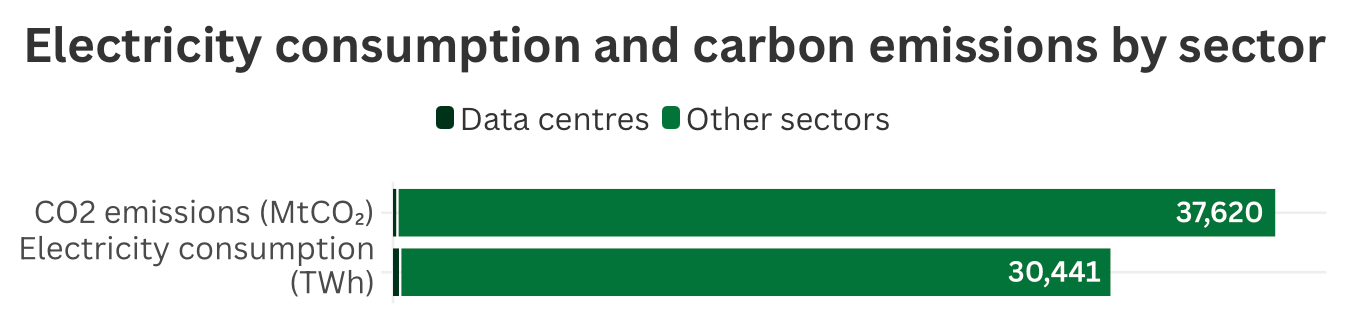
Given this starting point, even as data centres expand, they will make a relatively small contribution to climate change in the short term. The agency estimates that data centre emissions will reach 1% of global CO₂ emissions by 2030 in its current scenario, or 1.4% in a faster-growth scenario.
Read: Solar energy facts: a win-win for businesses and the planet
Strategic priorities for leaders
The important point for leaders is that AI’s electricity demand is not solely an environmental issue, although its emissions impact remains important. It is also a matter of growing energy demand, the need for infrastructure upgrades, and long-term commercial strategy.
There are no comprehensive global datasets on data centre electricity use, and projections vary significantly depending on assumptions about AI adoption rates, hardware efficiency improvements, and the actual number of data centre projects that reach completion.
But what is clear is that AI is now a first-order variable in electricity demand forecasting, grid planning, energy pricing, and investment strategy.
Organisations that integrate this understanding into their strategic planning early will be better positioned to navigate what comes next. The question is no longer whether AI will reshape electricity demand, but whether the energy sector is moving fast enough to meet it.
Get new articles on climate, energy and sustainability
Subscribe free, and get the UK Grid Toolkit: a Google Sheet with live UK electricity prices and generation data, updated hourly from NESO and Elexon.