How far has the EVs transition really come?
For most of the twentieth century, it was not possible to think about a car without the fuel. Today, things are changing faster than anyone expected.


As the adoption of electric vehicles (EVs) has increased enormously, the assumptions we had once that transport would always run on crude has now become questionable.
In 2026, BloombergNEF (BNEF) expects over 23 million passenger EVs to be sold globally. That is an 11% jump from 2025. The popularity of EVs have gone up enormously, especially since the recent war in Iran, which resulted increase in fuel prices.
If EV adoption continues to increase at this pace, we may not need as much fuel in the future as we do today, and at some point, we may no longer depend on it. BNEF estimates that total road fuel demand will peak in 2029, after which the fleet electrification and efficiency improvements will reduce its demand by 25.8 million barrels per day (mb/d) by 2040.
Read: Cars with wireless charging to transform global EVs market growth
However, if we want to imagine our life without fuels, we still need to deal with some challenges. For example, even though China has the largest share of the global EVs market, tighter eligibility requirements and increasing market maturity are slowing the growth.
In the U.S., EVs sales are projected to fall 19% this year following the rollback of federal support, including fuel economy targets and elements of the Inflation Reduction Act.
Another key barrier is an affordability. In major European markets, such as Germany, Italy and the UK, EVs are still around 17% more expensive than comparable internal combustion engine (ICE) cars. The gap has however narrowed significantly from 34% in 2024.
Figure 1 shows the number of new cars sold in last six years globally. In total, about 84.8 million cars were sold globally in 2025, of which about 25% were electric.
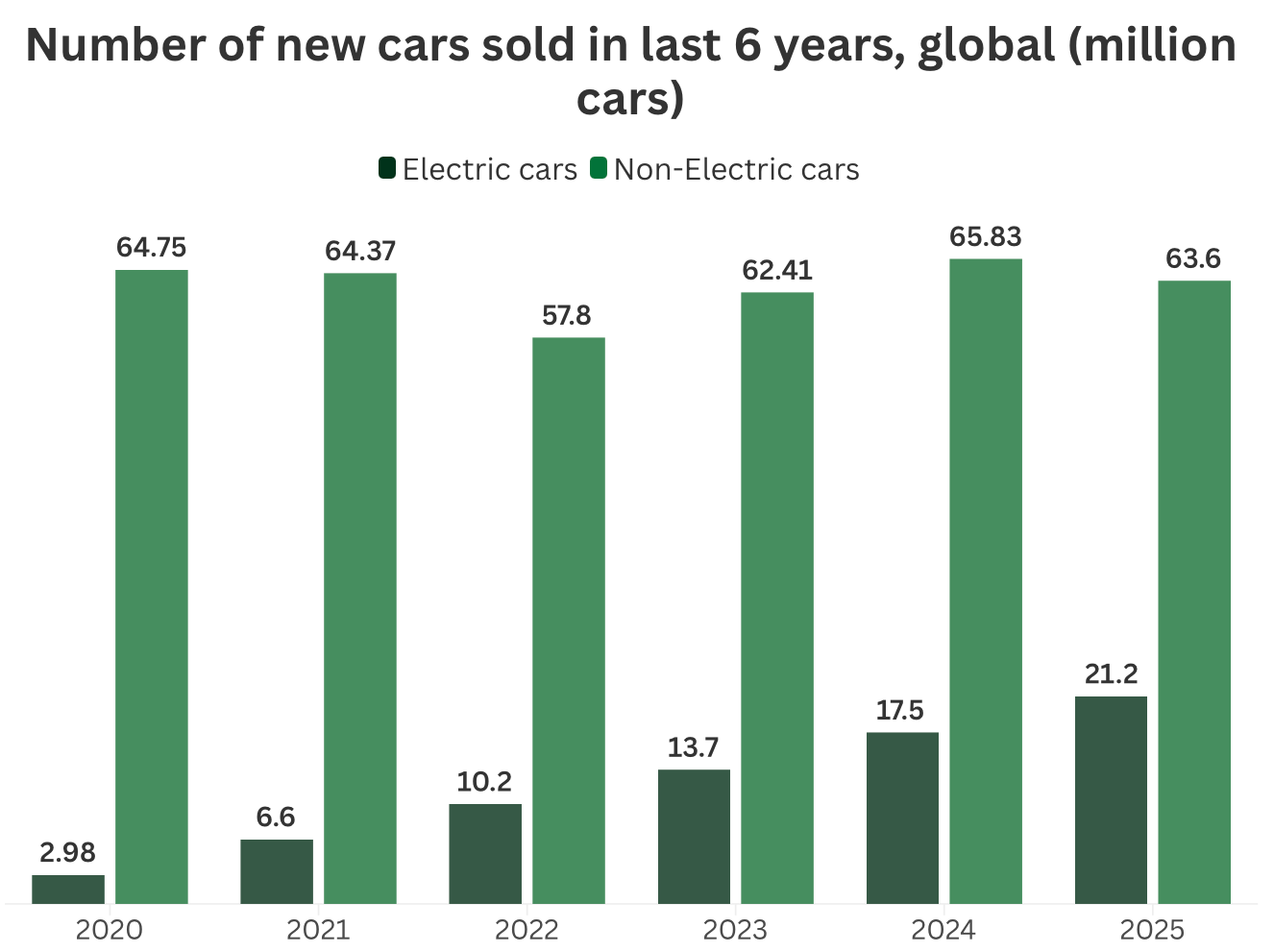
Currently, the global EVs fleet stands at more than 5% of all passenger cars on the road. This means we might still have sometime until we start seeing only EVs on the road.
Transition is uneven around the world
By the end of 2030, EVs are set to displace over 5 mb/d of diesel and gasoline globally, and China’s EVs are projected to account for half of that displaced oil.
The UK is the second-largest car market in Europe with EVs representing 30% of new car sales in 2025. Norway led with an impressive 97% while Germany’s 2024 withdrawal of subsidies weakened sales, leaving EVs with a 30% share.
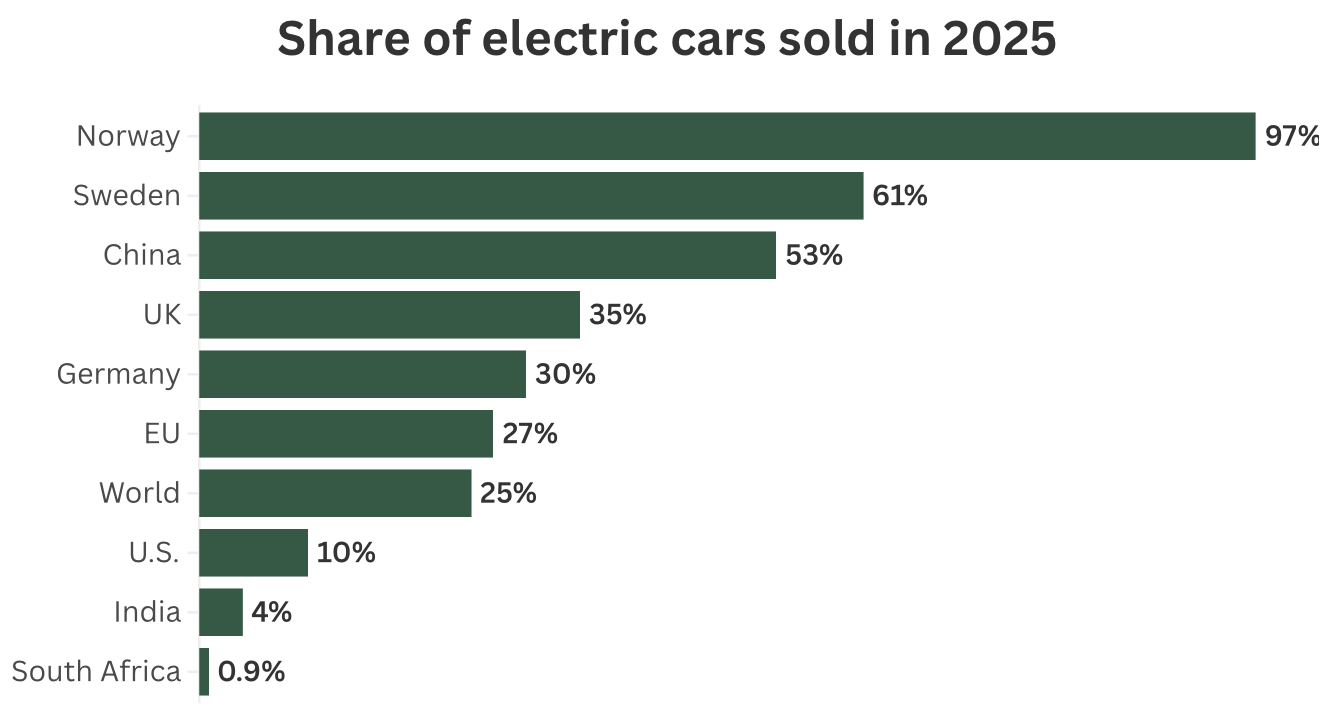
The U.S. presents the strongest case of political influence in the transition. BNEF expects the country's EVs sales to fall 19% in 2026 due to the withdrawal of federal regulatory support. Last year, their electric cars represented 10% of the total sales and we are expecting only 24% of the U.S. car fleet to be electric by 2040, far behind China and Europe.
When could EVs become irreplaceable
Global fuel demand for road transport is approximately 45 million barrels per day. Even a 1–2% reduction in that figure represents well over half a million barrels per day. As more EVs enter the fleet and older ICE vehicles age out, it compounds annually.
BNEF’s 2026 EV Outlook estimates that over half (52%) of all passenger vehicles sold globally will be electric by 2035. By that point, the fuel displacement is expected to accelerate even without further policy intervention.
Furthermore, when we think about an estimated remaining usable fossil fuels at current consumption rates, we certainly need to find the alternative fuels anyway. Although this transition will take time and some investment, the way EVs are developing suggests that our fuel-free road is increasingly achievable in future.
Read: When will fossil fuels run out?
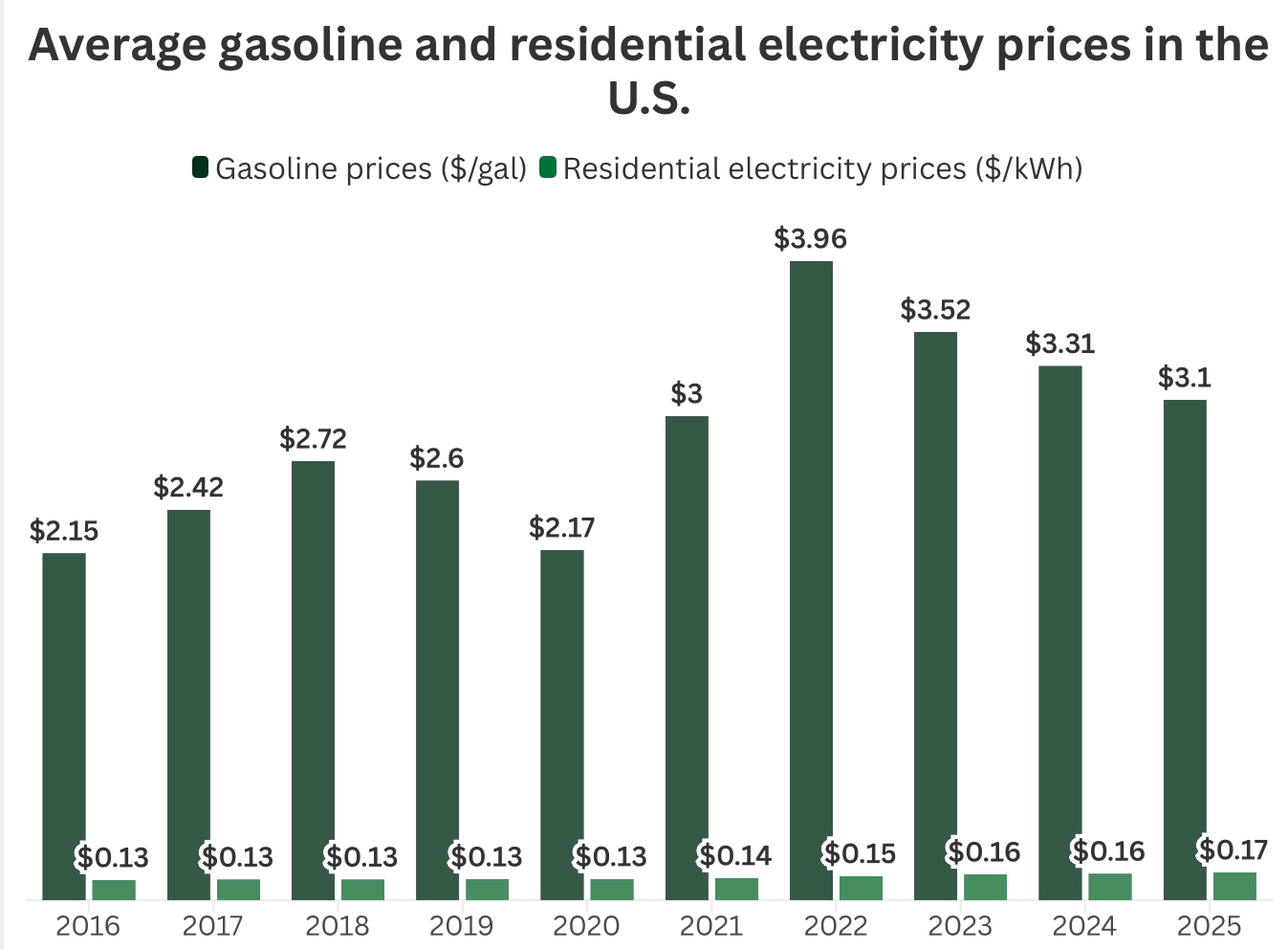
At some point when the customers realise that electricity is more reliable and cheaper than fuels (Figure 3), they will also be more open to EVs.
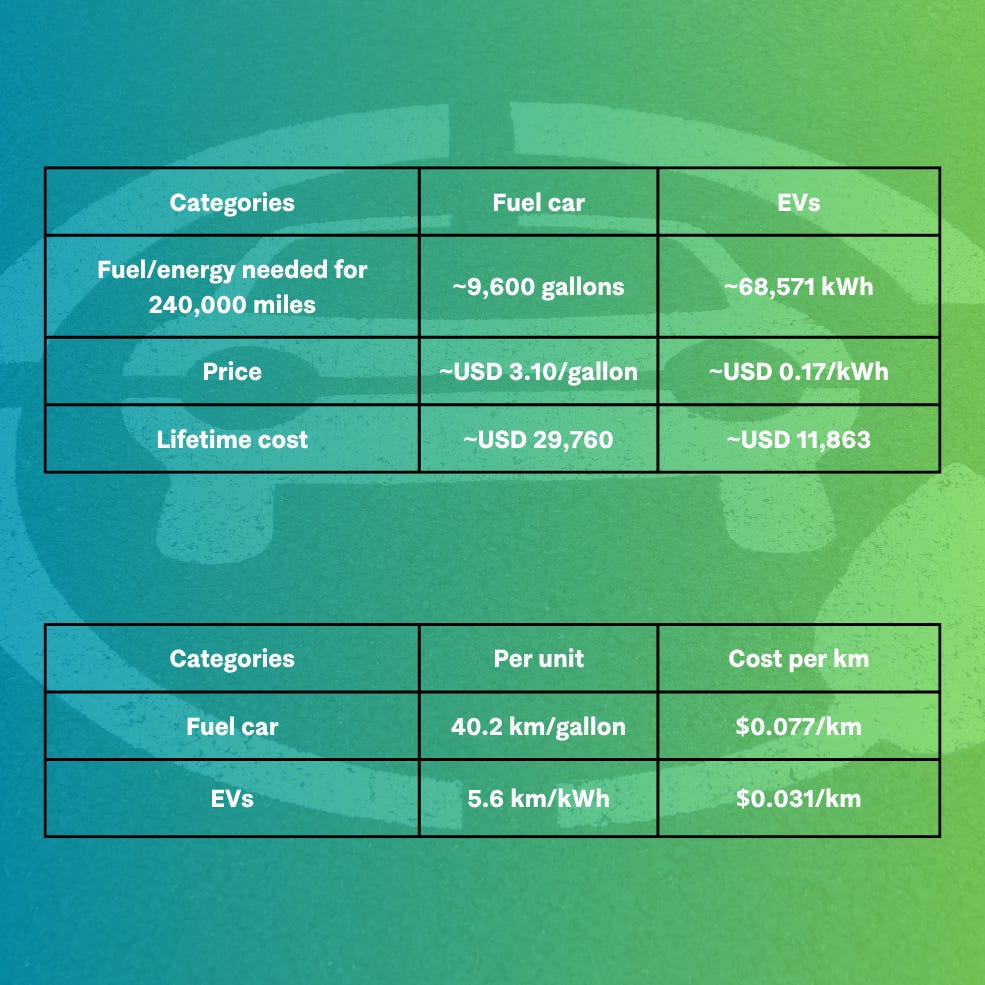
For example, Figure 4 shows the cost comparison between electric and gasoline vehicles based on the data above. The figure takes an example of a car with a lifetime of 20 years and assumes that car runs 240,000 miles (386242.56 km) during that time. Over that distance, a gas car needs about 9,600 gallons, whereas an electric needs about 68,571 kWh.
Now, using estimated 2025 energy prices of $0.173 per kWh for electricity and $3.10 per gallon for gasoline, the difference is clear. Even though EVs need more energy units to cover the same distance, that huge price gap means EVs still cost about $0.031/km to run versus $0.077/km for gas cars.
Read: The critical role of power sources in the climate crisis
What's next for the fuel market?
If the oil industry wants to continue as they have now, their only option is to focus on the sector that electrification cannot easily touch. For example, petrochemicals, aviation, shipping, and heavy industry.
The petrochemical industry is now expected to become the main source of oil demand growth from 2026 onwards, and is on track to consume one in every six barrels of oil by 2030.
In the EU, regulations are pushing major reductions in fuel use and emissions, which is increasing the development of electric and alternative fuel systems. However, questions remain about whether full electrification can meet all heavy-duty needs.
Combustion engines are still likely to remain important for heavy-duty transport even beyond 2050, especially when running on low- or zero-carbon fuels, such as biofuels, e-fuels and hydrogen.
Regarding electric planes, many big companies, like easyJet, Boeing, Airbus, and NASA, are building electric or part-electric planes. These planes use batteries, like the ones in electric cars, instead of fuel.
The problem is, batteries are still too heavy for the plane, the airports need new equipment to charge them and building new planes requires huge investment and time. Because of this, it will be a while before we can fly on electric planes.
But the data we have seen so far says that the technology is no longer the limiting factor. The electric cars are getting popular, the batteries are getting cheaper, and the infrastructure is spreading. The only real question is how quickly governments and consumers decide to make the switch.
We cover renewable energy, climate risk, and sustainability economics. Subscribe to get new articles in your inbox.