Cut your business electricity bills by changing when you use it
Wherever a business is located, the same unit of electricity can cost almost nothing at one hour and much more a few hours later. So a business that moves even part of its usage into the cheap hours can make a real difference in its electricity bill.


When renewables produce more electricity than people need, wholesale prices fall. But in the opposite scenario, gas often sets the price, which makes the bills expensive.
Renewables tend to supply the least when demand is highest, especially in the early evening. That is why it’s challenging to bring the bills down.
In the UK, renewables generated 52% of electricity in 2025, more than doubling since 2016. Across the EU, their share rose from 30% to 48% over the same period. The U.S. and India are further behind but moving along the same way (Figure 1).
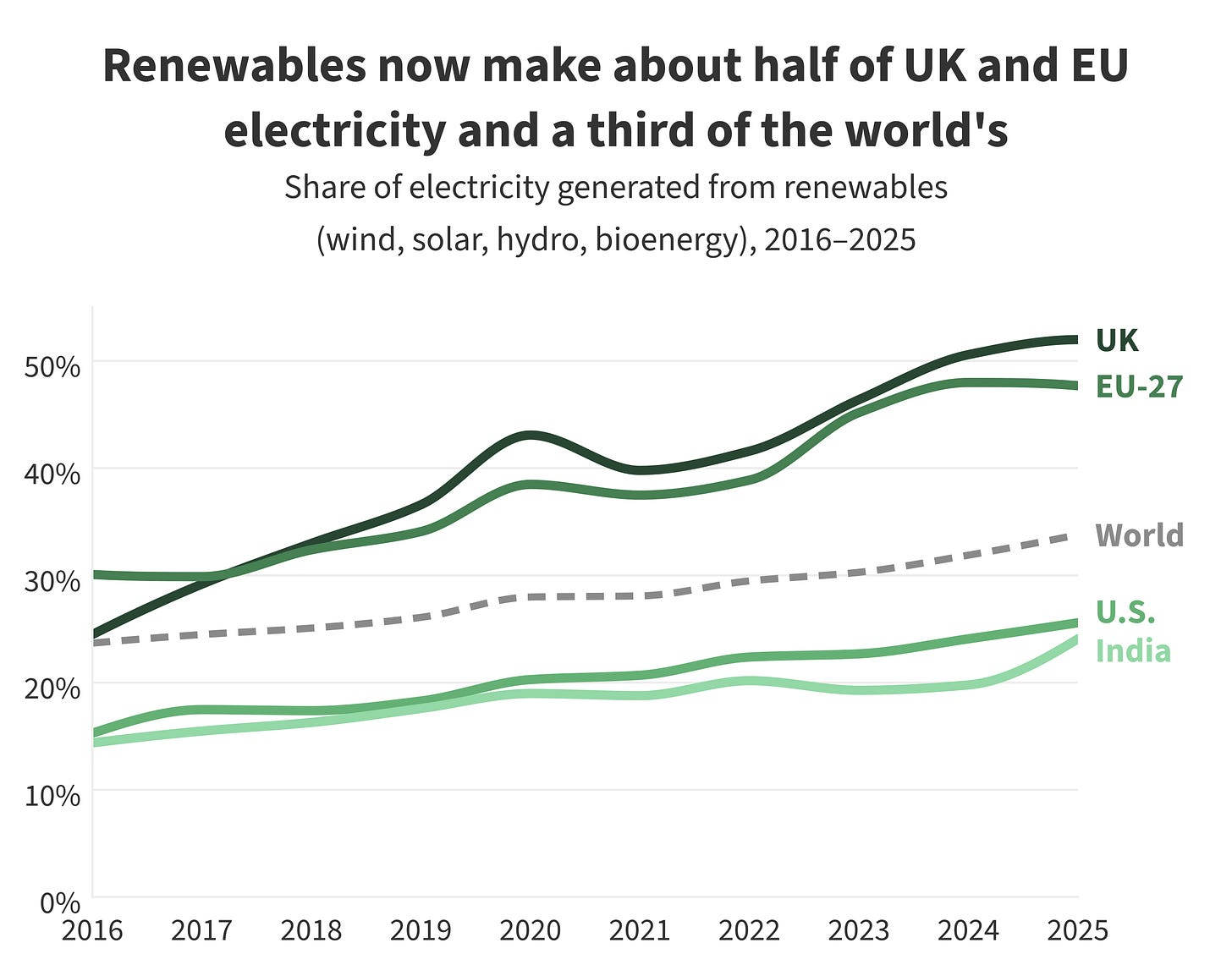
Wind and solar matter most for prices, because their output depends on the weather and the time of day. As they generate more and more electricity, the gap between cheap and expensive hours is likely to grow further. That makes the timing of electricity use more valuable for businesses.
So for a business, the question is not how expensive electricity is, but whether it can run its electricity-intensive operations during cheap hours.
Related: Renewables are booming but our electricity bills are still rising
Pay less by choosing your working hours
Octopus Energy launched the Shape Shifters: Agile tariff in Britain in November 2025. This tariff aims to help the businesses using 50,000 kWh a year save up to £3,500.
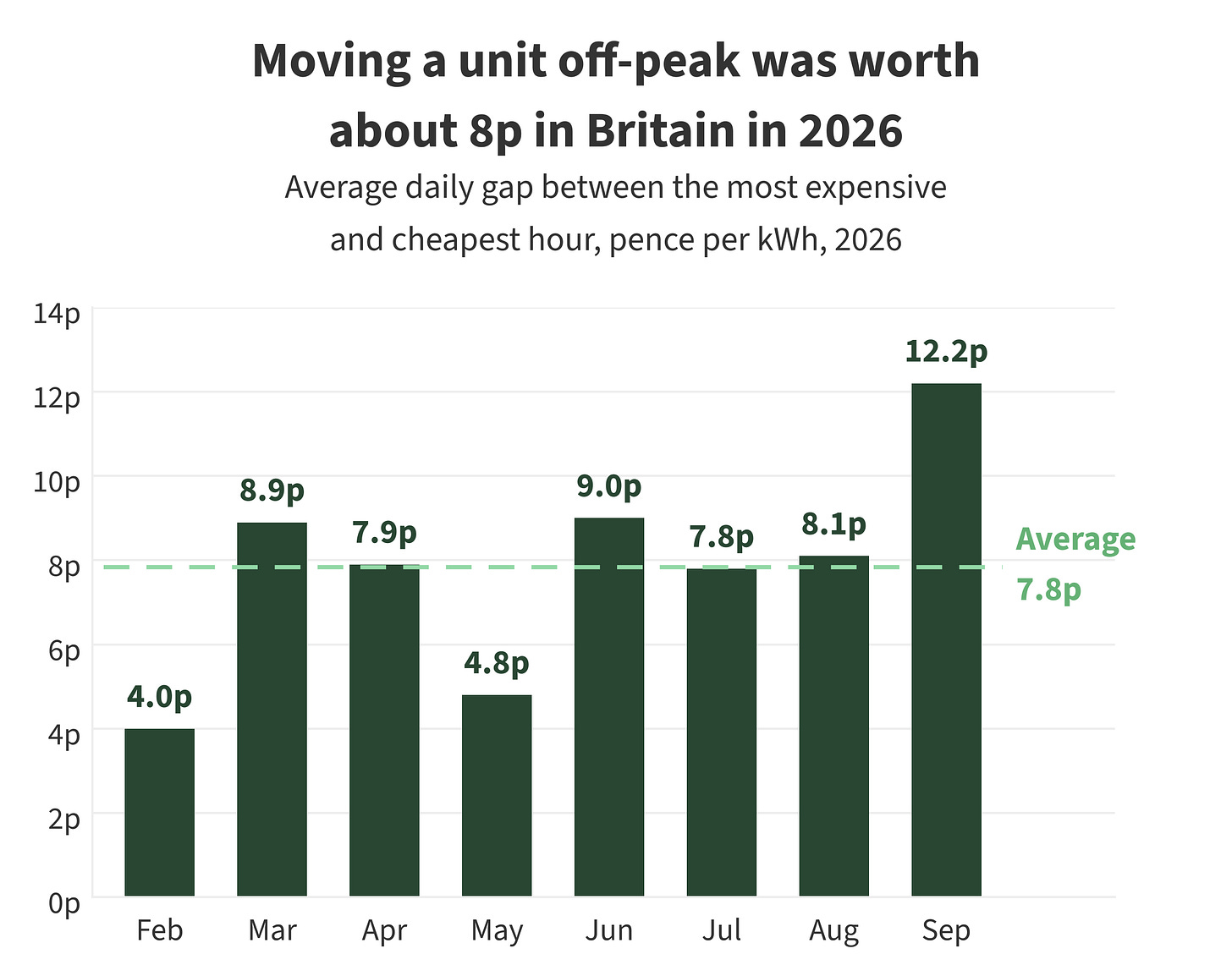
All they have to do is move their use out of peak hours, which are typically 4pm to 7pm. Based on Modo Energy’s monthly battery revenue reports, the average daily gap between the most expensive and cheapest hour was about 7.8p per kWh between February and September 2026 (Figure 2).
And What does that mean for a business’s bill? Most businesses on a flexible, half-hourly tariff pay prices based on the day-ahead market. This means electricity that is going to be used tomorrow is bought today.
So according to Modo Energy’s report, businesses who moved their use of electricity from the most expensive hour to the cheapest could save about 7.8p per kWh on average.
Our UK Grid Toolkit tracks Britain’s real-time prices. Elexon uses this price every half-hour to settle up when energy companies use more or less electricity than they planned on the day-ahead market.
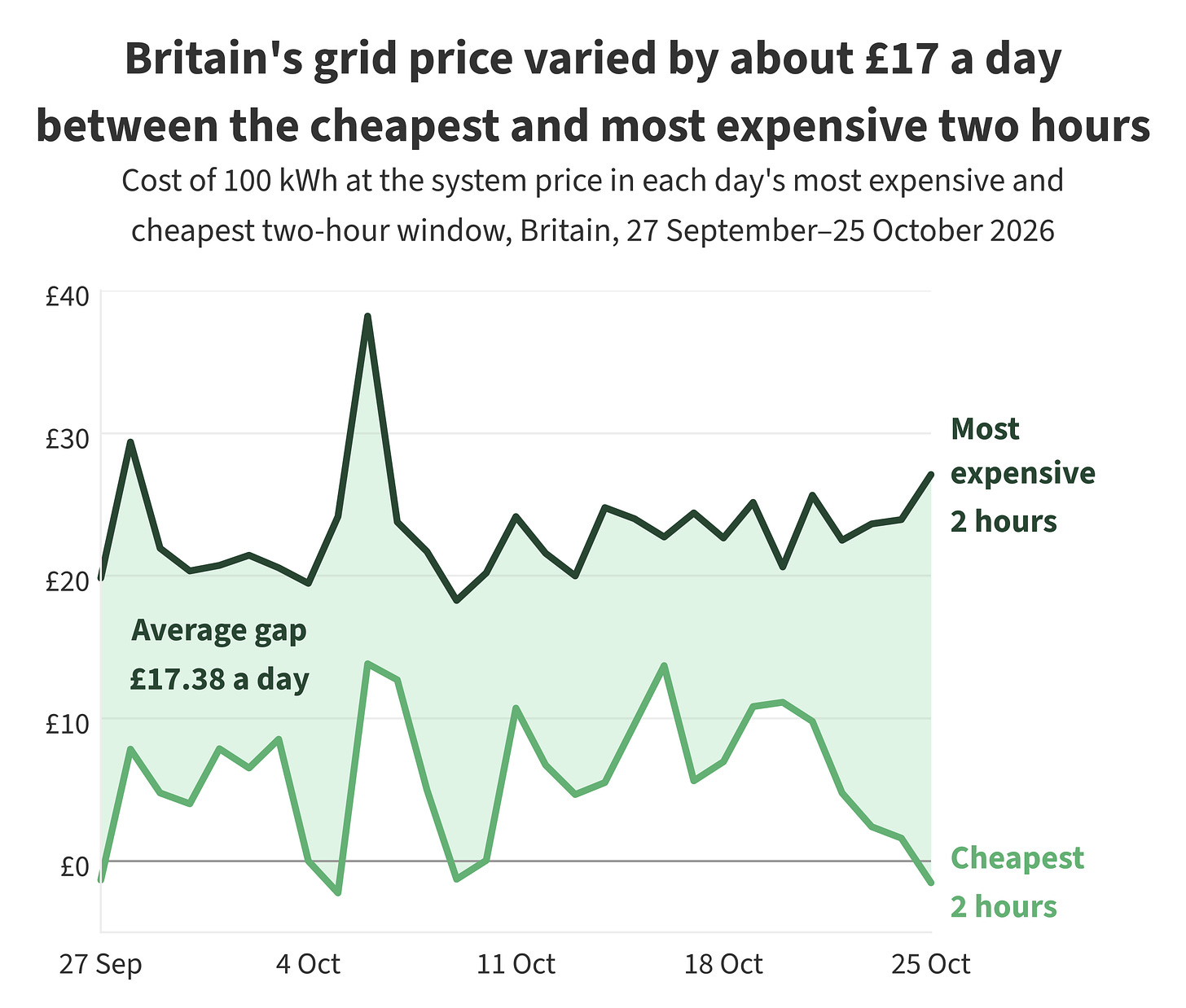
Because it reacts to what actually happens on the grid, it is more volatile than the day-ahead price (Figure 3).
For this example, we priced 100 kWh in each day’s cheapest and most expensive two-hour window from 27 September to 25 October. The average gap was £17.38 a day, which is about 17p per kWh. That is roughly twice the 7.8p gap on the day-ahead market.
There are mainly two reasons for it. The real-time prices or system prices are more volatile and also autumn evenings push prices higher. This gives a fair guideline for businesses who want to avoid the evening peak but also want to check each day to catch the best price.
How Texas businesses cut their bills at peak times
In parts of the U.S., grid operators pay large businesses for using less electricity when supply is tight.
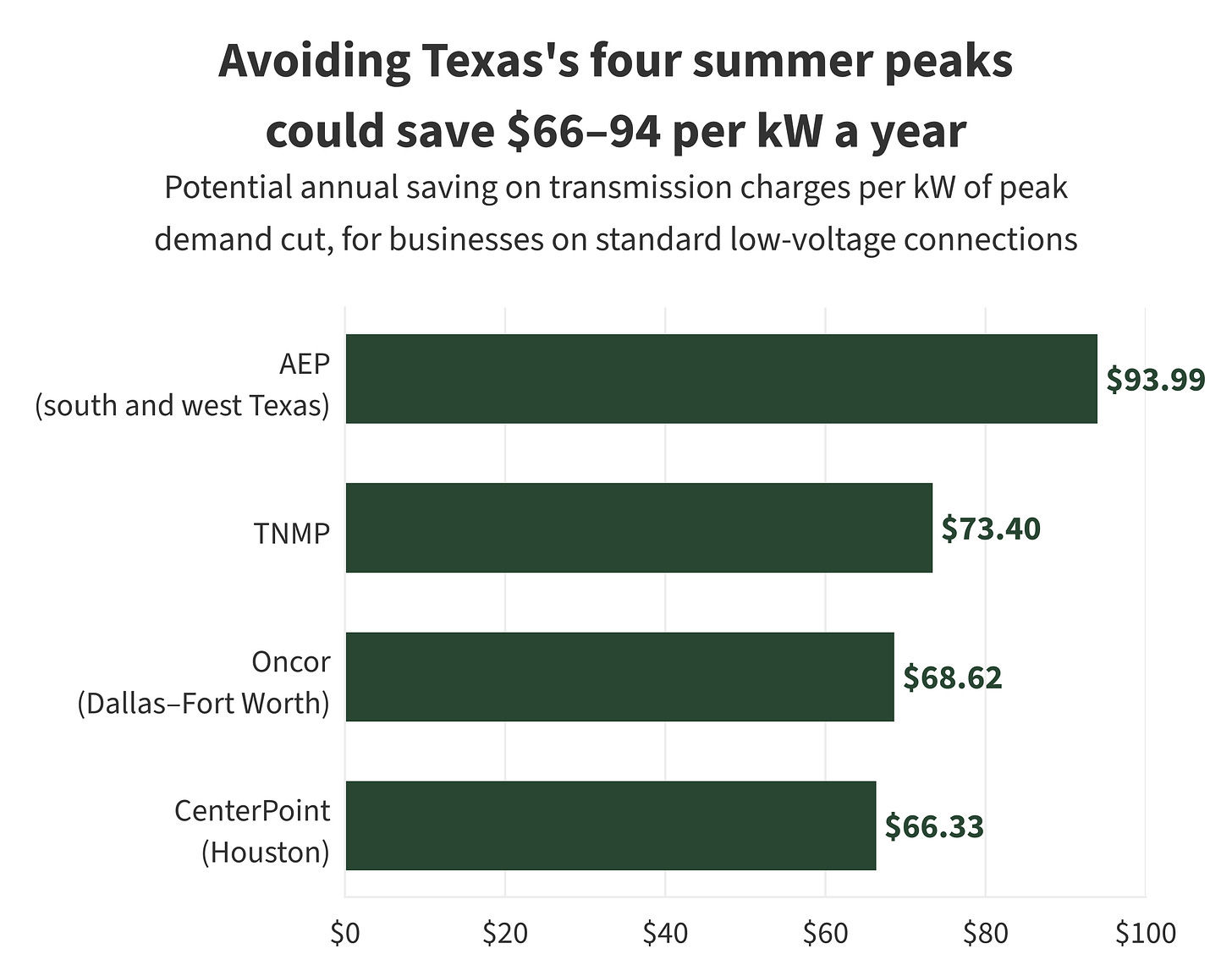
For example, in much of Texas, large businesses pay transmission charges for a whole year based on how much electricity they used during the grid’s four busiest 15-minute periods the previous summer, known as 4CP. If businesses can cut usage in just those four moments, they can lower the bill for the next 12 months.
For large sites, such as supermarkets, distribution and cold-storage warehouses, the potential saving is $66–94 a year for every kW of peak demand cut (Figure 4). Since 2012, 95% of the peaks have fallen on weekdays between 4-5pm.
Related: UK manufacturers can claim up to 25% off electricity bills, but gas keeps prices high
Businesses are saving the electricity cost already
Some of the notable examples come from cold stores, which have to keep their refrigerator on all the time.
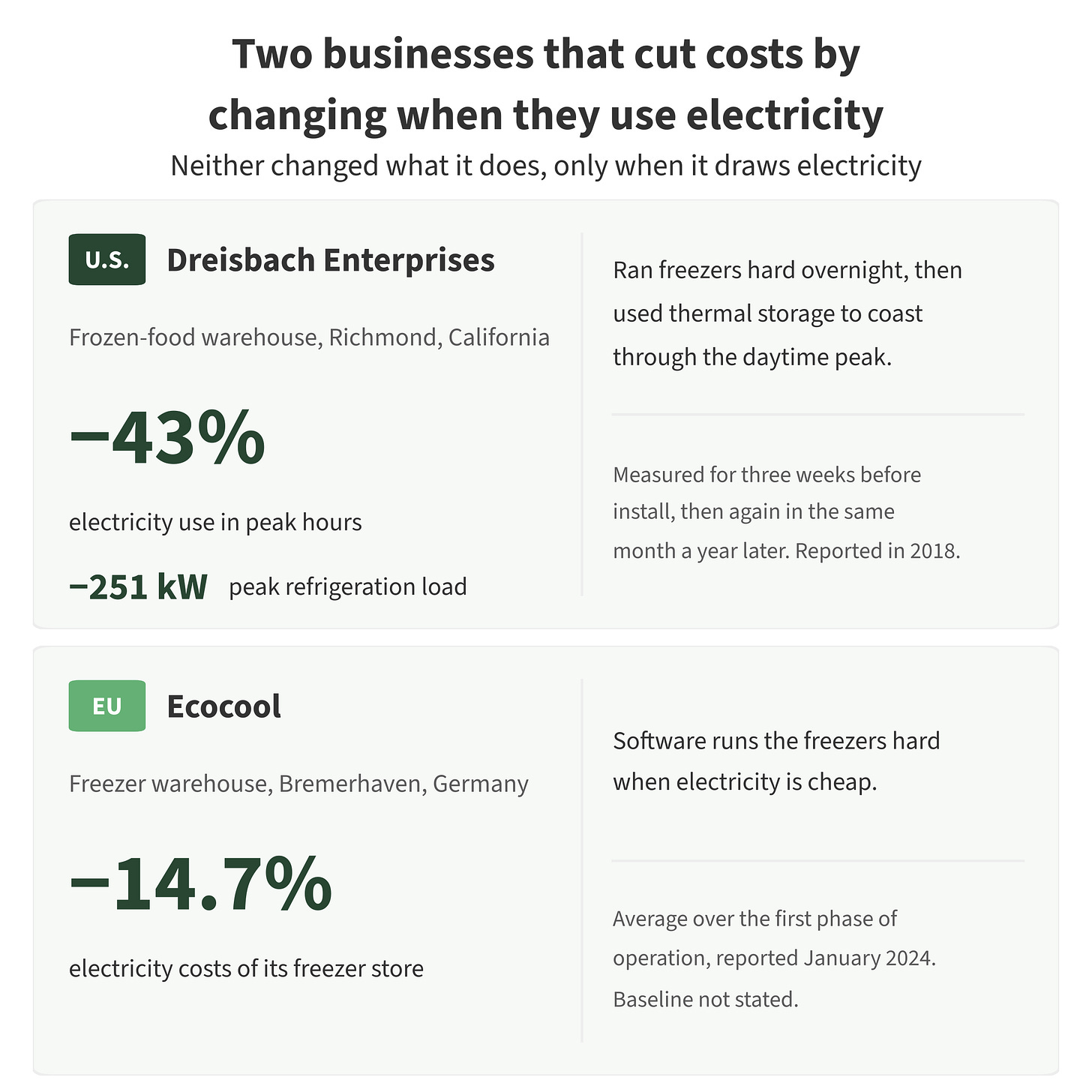
Dreisbach Enterprises’ frozen-food warehouse in Richmond, California, started running its freezers hard overnight, and used thermal storage throughout the daytime peak. As a result, its electricity use in peak hours fell by 43% (Figure 5).
Another good example is Ecocool, located in Germany. It uses software that runs its freezers when electricity is cheap. The cost fell by about 14.7% in the first phase.
In Britain, Burgess Pet Care, a pet-food maker business has signed up to the Capacity Market. This scheme pays businesses to help the grid at its tightest moments.
The company made no new investment and reported no disruption to production, but still earned about £5,500 from October 2025 to September 2026 by cutting their electricity usage temporarily when grid is under stress. It expects to earn around £10,000 a year under a three-year agreement, according to CUB, the energy consultancy that arranged it.
The main thing these companies did was changed the time they use electricity, and that was enough to cut their costs and even earn in the case of Burgess Pet Care. Because as renewables grow, some hours will always be cheaper than others. Businesses just need to be open to the idea of being flexible.
Get new articles on climate, energy and sustainability
Subscribe free, and get the UK Grid Toolkit: a Google Sheet with live UK electricity prices and generation data, updated hourly from NESO and Elexon.