UK manufacturers can claim up to 25% off electricity bills, but gas keeps prices high
Manufacturers in England, Wales and Scotland have until 30 November to apply for a government scheme that could help them cut their electricity costs by up to 25% from April 2027.

Applications for the British Industrial Competitiveness Scheme (BICS) opened on 1 October and more than 10,000 manufacturers are expected to be eligible, with savings of up to £40 per megawatt hour (MWh).
How the scheme works?
UK industrial electricity prices are the highest among its European neighbours, and the goal of this scheme is to narrow that gap.
Data from the Department for Energy Security and Net Zero (DESNZ) shows how wide the gap has become. In the second half of 2025, UK industry paid more for electricity than any of 14 European countries, in every size band. DESNZ categorises these businesses into different users:
- Small users: 20–499 MWh a year
- Medium users: 2,000–19,999 MWh a year
- Large users: 20,000–69,999 MWh a year
- Very large users: 70,000–150,000 MWh a year.
Figure 1 shows that small users paid 29.08p per kWh, 55% above the median, while large users paid 23.37p, more than double the median of 10.16p.
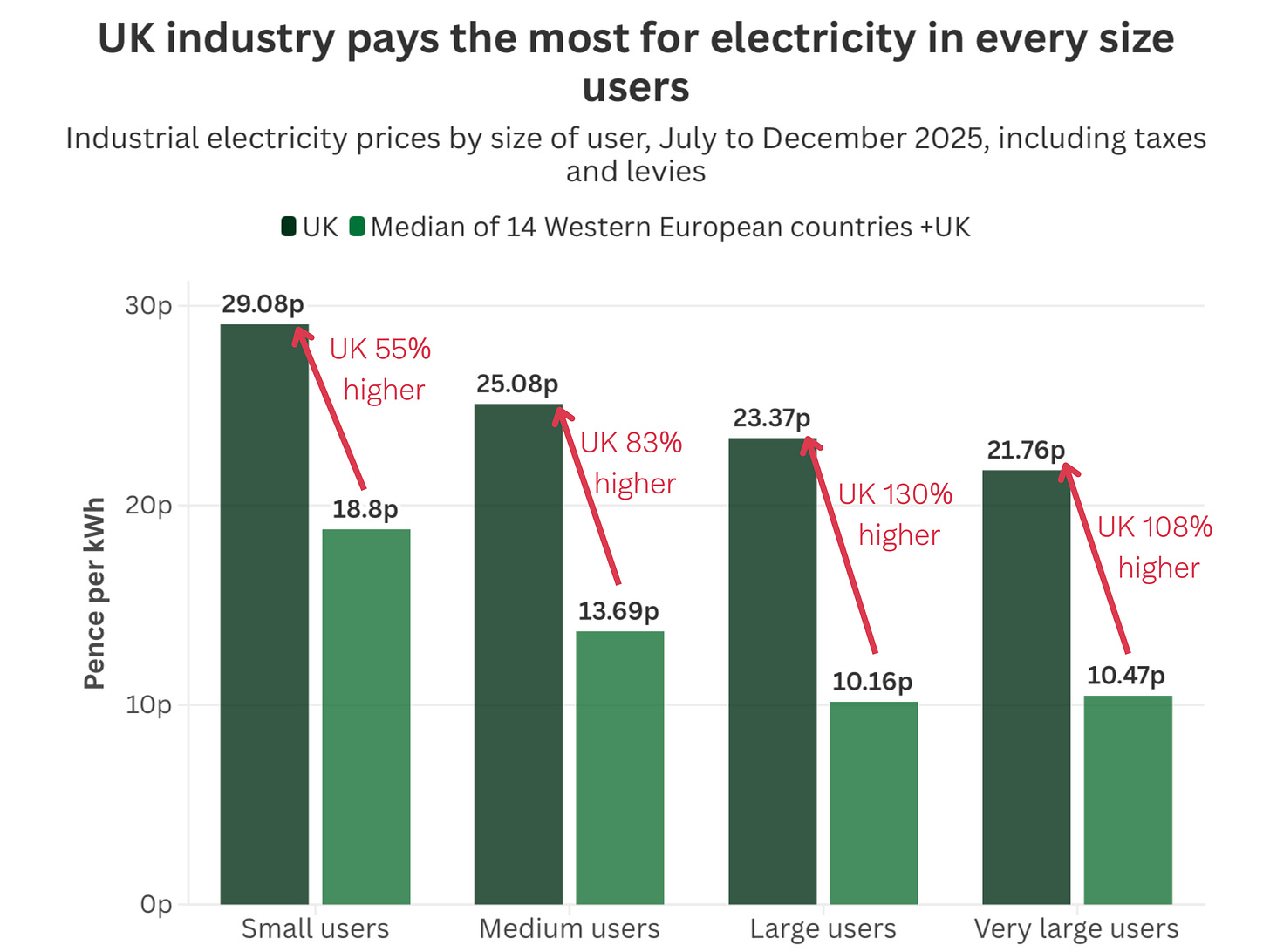
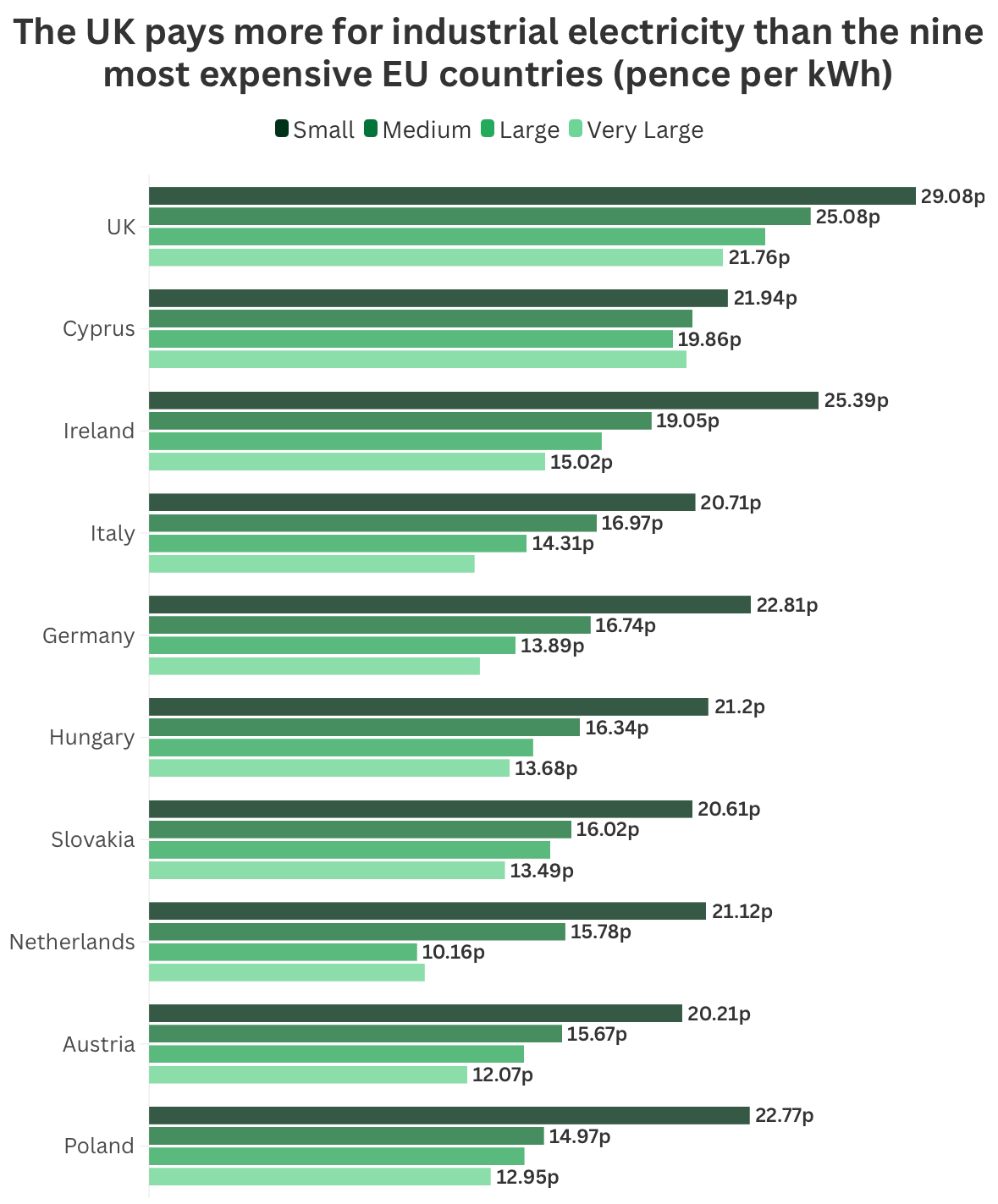
Figure 2 compares UK electricity prices with those in the nine most expensive EU countries. For example, UK medium users paid 25.08p per kWh, 22% more than Cyprus, the next highest.
The good news is BICS is open to manufacturers of any size, provided each site uses at least 33 MWh of electricity annually. As Figure 1 shows, the gaps are especially wide for large and very large users (130% and 108% above the median, respectively), and schemes such as this are intended to help narrow them.
But not everyone thinks the scheme goes far enough. Chemicals group INEOS welcomed BICS but argued that British industry relies more on gas than electricity. The company has called for immediate reforms to industrial gas pricing and lower carbon taxes if the UK is serious about protecting manufacturers affected by energy bills.
Ceramics UK chief executive Rob Flello questioned the lack of transparency in the decision-making, as only a small number of ceramics manufacturers are eligible. He asked why producers of concrete bricks and tiles are eligible while clay brick and tile makers are not.
Electricity prices are still rising
In one of the webinars last month, conducted by Cornwall Insight, which I participated, they discussed how the businesses of all sizes can expect energy costs to keep rising until the end of the decade.
Figure 3 shows a chart (shown during webinar) that tracks electricity costs for six kinds of business site from 2025-26 to 2028-29. Costs are expected to rise sharply in 2026-27.
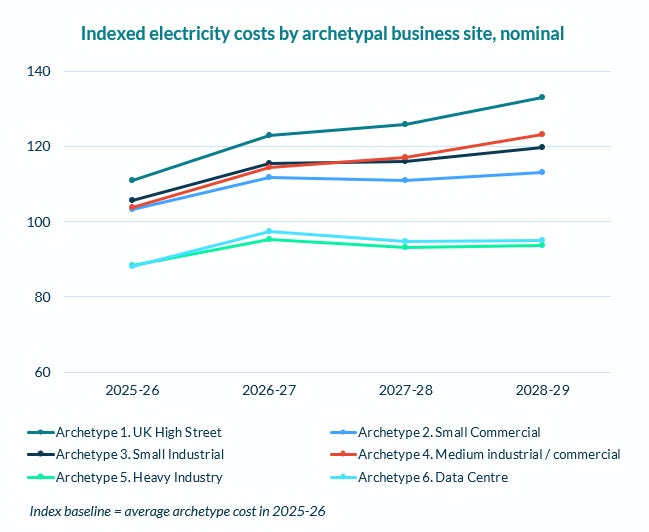
After 2026-27, electricity costs for high street and medium-sized commercial businesses are expected to keep climbing, while heavy industry and data centre dip slightly. As BICS is designed to remove some of those costs for eligible manufacturers, high-street and smaller commercial businesses, who are not covered by BICS will be hugely affected.
Cornwall Insight points to three drivers:
- Wholesale power and gas prices staying high beyond this year
- Electricity network costs rising throughout the decade
- The overall cost of new and exciting policy schemes growing before 2030.
Jacob Briggs, Energy Users Lead at Cornwall Insight, said:"Energy costs are not just an energy policy issue. The effects of rises and falls are felt across economy. This is true for households and businesses of all sizes, where energy costs are consistently highlighted as one of the principal pressures businesses are feeling".
Related: Are energy costs eating your margins? Solar might be the answer
Gas still sets the price
Ofgem data supports Cornwall Insight's warning about wholesale prices. Figure 4 shows the weekly average electricity prices in Great Britain since February 2021.
Although they fell sharply through 2023 after the energy crisis stabilised, they have not returned to their earlier level. After dipping to around £70 in early 2024, prices climbed again this year.
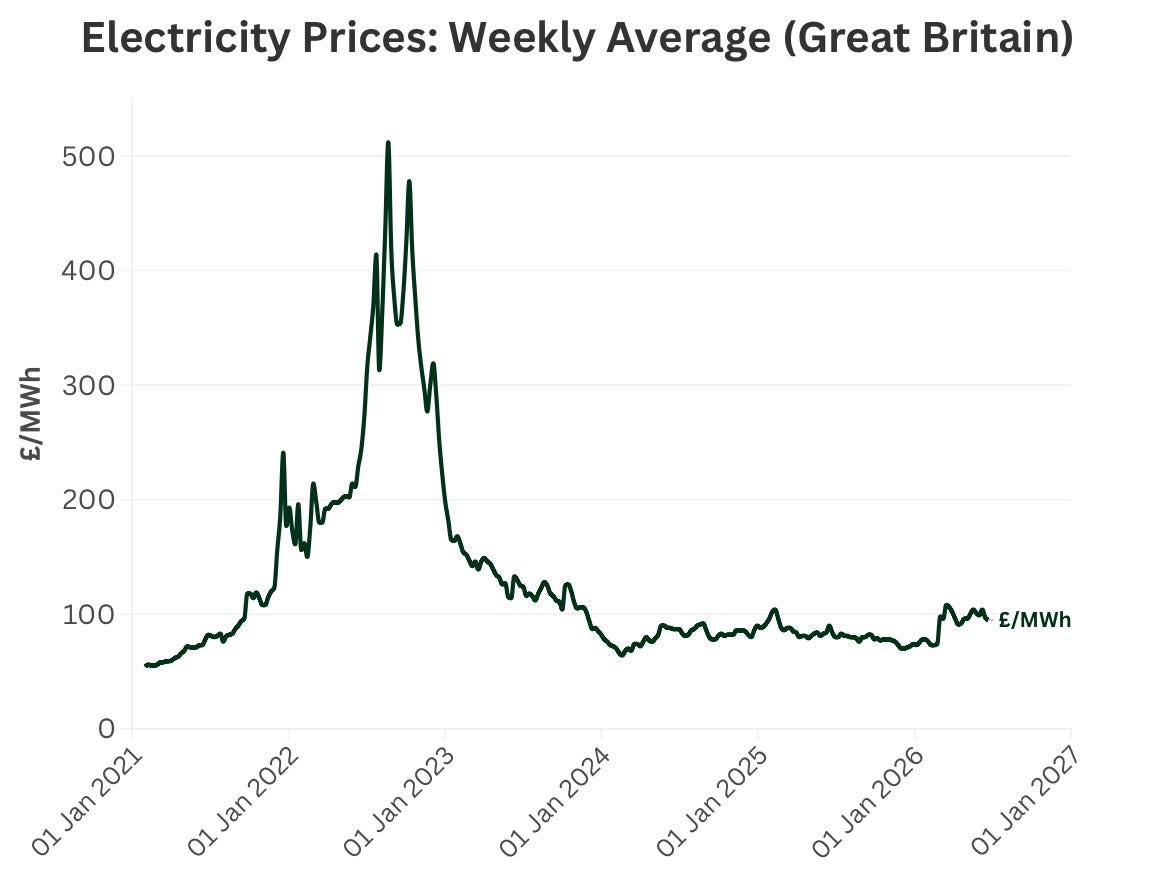
Ofgem says gas-fired power stations often set the price of electricity as high gas prices feed into power costs. However, renewables are becoming increasingly important in setting power prices although their output depends on the weather.
Related: Renewables are booming but our electricity bills are still rising
Our own analysis shows how much Britain still relies on gas when renewable output drops. The Green Solutions’ UK Grid Toolkit shows how sharply the mix can swing. Over the past month (mid-September to mid-October), low-carbon sources (renewables and nuclear) supplied more than half of Britain's electricity on about 15 days. On the other days, they supplied less than half, and gas made up much of the rest (Figure 5).
This shows that the challenge we have at the moment is not only to cut costs but to understand the whole cost, and what it means for future budgets and decisions. BICS tackles one part of that picture—policy charges built into every electricity bill.
The government says the scheme will help manufacturers manage energy costs, support investment and protect jobs. Business Secretary Jonathan Reynolds said: "We will reindustrialise Britain by tackling one of the biggest pressures facing manufacturers and cutting their electricity bills.
“I’d urge every eligible manufacturer to get your application in for the British Industrial Competitiveness Scheme. This support will help companies spend less on energy and more on growing their business, unlocking the growth we want to see across the country.”
For now, BICS will be welcomed as part of wider efforts to address high electricity prices. However, while it will ease the pressure on thousands of manufacturers, it does not tackle the root cause. As long as gas sets the price of electricity, UK businesses will remain exposed to global gas markets and bills are likely to stay high.
Get new articles on climate, energy and sustainability
Subscribe free, and get the UK Grid Toolkit: a Google Sheet with live UK electricity prices and generation data, updated hourly from NESO and Elexon.