How do digitally transformed companies drive sustainability to new heights?
Harvard Business Review 2023 stated that 89% of large companies globally have a digital transformation underway but Forbes assessed the risk of failure in digital transformation to be about 84%.


Although the technological revolution, customer demand, and the necessity to stay competitive have initiated digital transformation, various other factors have undeniably propelled the momentum in the last few years.
The global effect of the COVID-19 pandemic made businesses suffer an unparalleled period of crisis, with the disruption of established supply chains. The conflict in Eastern Europe added further strain to the situation.
This series of disturbing environments has led to shortages of key materials, resulting in substantially elevated input costs. The digitize-to-survive mindset of businesses has responded to dynamic market changes, ultimately fostering innovation and enhancing resilience.
What is digital transformation?
Digital transformation involves the integration of digital technology to convert non-digital business processes and services into digital formats. This includes activities such as adopting tools for communication and collaboration and implementing automation in various processes.
For example, the current work culture demands hybrid work models, which need an increased focus on cybersecurity in the workplace. Remote teams are tasked with remaining vigilant against sharing scams, emphasizing the importance of cybersecurity.
Additionally, customers now seek assurances regarding the security of their data and the preservation of their privacy. The IT security teams must ensure that the ongoing digital transformation prioritizes data security and processes.
Digital transformations have a great potential for value creation. However, given the rapid pace of technological evolution, businesses must prioritize successful execution.
How businesses can prepare for digital transformation?
Across various domains, the current trends in digital transformation are oriented toward enhancing overall efficiency. This includes improved management of technology, effective handling of data and processes, and automation.
Eliminating human intervention in these processes results in faster and more precise workflows. However, the intent is not to replace people with software but to empower them with software that manages routine tasks, freeing people to focus on creative problem-solving.
A journey to digital transformation for companies is distinct and characterized by unique goals, strategies, and technologies tailored to the specific business case. The initial phase involves pinpointing the issues to be addressed by conducting a SWOT analysis.
Also, identifying key performance indicators (KPIs) that highlight the necessity for change is crucial, as these KPIs become critical metrics for gauging the success of transformation efforts. The chosen technology should exhibit the flexibility to align with the current business processes, the objectives of the transformation, and the scalability necessary to accommodate future growth.
Related: The rising interest in tracking Scope 4 emissions
GE Healthcare for example has strategically embraced digital transformation and AI into their business. Through this implementation, the company has successfully enhanced maintenance procedures, minimized downtime, and elevated the quality of customer service provided. The digital-based solutions further support the overall integration of GE Healthcare's sustainable initiatives, spanning from manufacturing, product utilization, and eventual expiration.
Kelvin Sanborn, the ESG Program Leader at GE Healthcare, emphasized the company's commitment to addressing the environmental impacts of its products throughout their life cycle. Sanborn highlighted the company's potential to make a substantial impact on healthcare's carbon footprint by focusing on the design of durable, energy-efficient, and high-quality imaging equipment.
Companies plan to increase investment in digital transformation
The PwC Digital Factory Transformation Survey 2022 gathered insights from over 700 manufacturing companies worldwide and claimed that the sector is allocating USD 1.1 trillion annually towards digital transformation solutions.
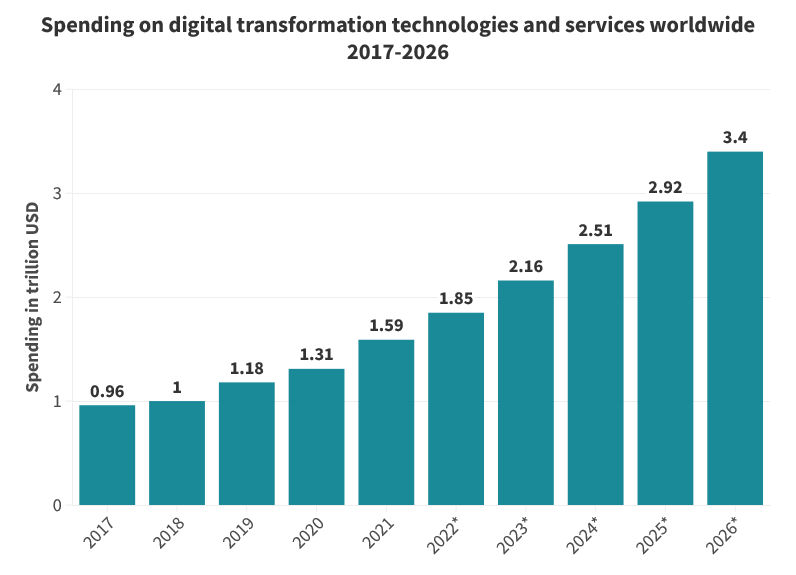
Overall, the anticipated expenditure on digital transformation in all sectors was USD 1.85 trillion in 2022, projected to hit USD 3.4 trillion by 2026 (Figure 1).
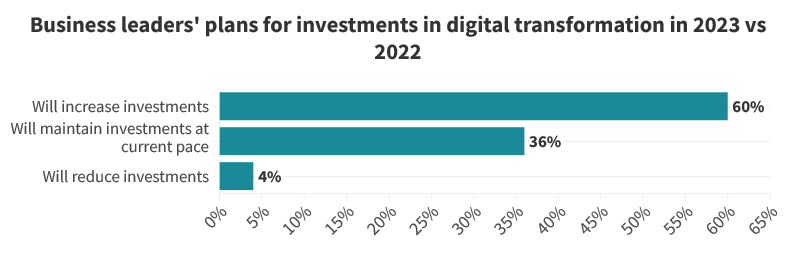
The leaders are keen to invest more in digital transformation as discovered by BCG's 2022 survey involving over 2,700 leaders in larger companies (with 1000 or more employees) across 13 countries worldwide.
The findings revealed that 60% of executives planned to increase their investment in digital transformation in 2023 compared to 2022 (Figure 2). Only 4% intended to reduce their investment, while the remaining 36% planned to maintain their current levels of investment. Leaders are strategically focusing on two primary areas: business model transformation and sustainability.
How sustainability is connected?
Fujitsu Future Insights Global Sustainability Transformation Report 2022 surveyed 1,714 business leaders across nine countries. The focus was on management and decision-makers in companies with 500 or more employees.
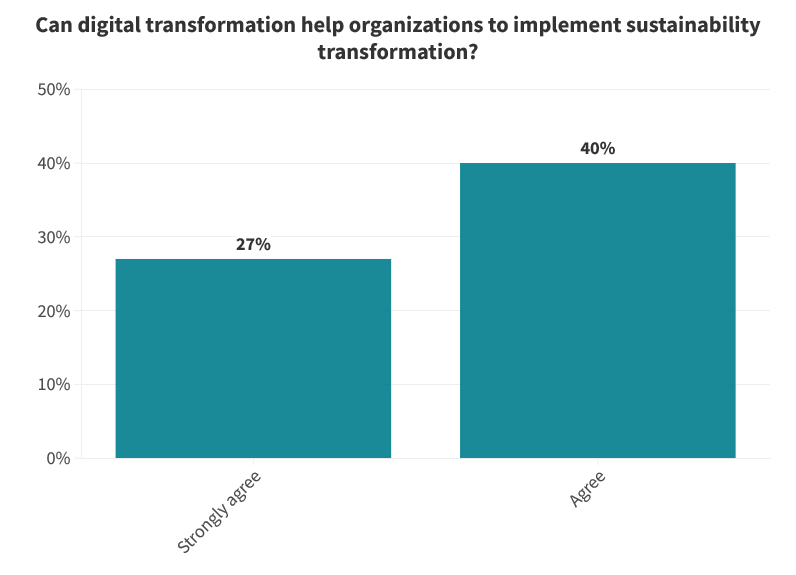
A significant 67% of respondents acknowledge the positive impact of digital transformation on the success of sustainability transformation (Figure 3). Out of 67%, 40% strongly believe that digital transformation helps organizations to implement sustainability transformation.
Both sustainability and digital transformation share a similar essence; sorting out the latter makes the former easier and smoother.
Digital transformation consists of integrating the cultural, technological, and process changes that are necessary to enhance sustainability. And the businesses nowadays do not have much choice because all stakeholders, from investors to customers to employees prefer to see their companies implementing sustainability strategies.
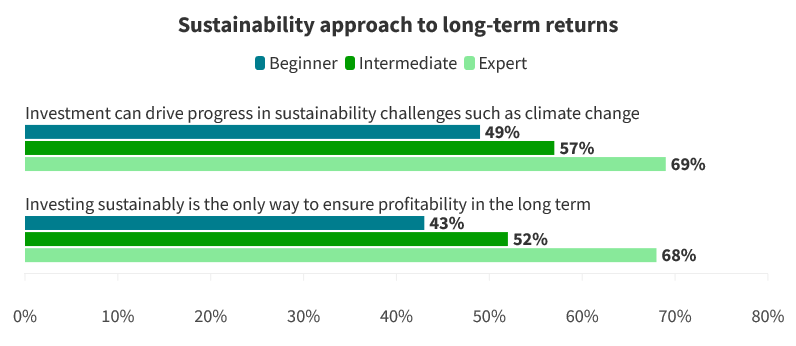
According to the 2022 Schroders Global Investor Study, 69% of advanced investors consider sustainable investing crucial in the fight against climate change (Figure 4). The study included over 23,000 investors across 33 global locations. In comparison, 57% of intermediate investors and 49% of beginners share this perspective.
While many organizations possess the capability to digitalize in various business areas, the question arises whether it is a matter of cultural change hindering progress in sustainability despite ongoing investments in this domain.
Current challenges
Financial challenge is always the first concern. However, the commitment and confidence demonstrated by business leaders in digital transformation are highly promising despite some challenges. The top five concerns are as follows:
- Difficulty in navigating the rapidly expanding technologies, such as AI, Blockchain, and the IoT.
- Implementing the new digital solutions from initial pilots to full-scale across the entire business.
- Prioritizing investments and development efforts effectively.
- Managing the costs and uncertainties associated with the return on investment.
- Finding skills and talent required for the successful implementation of their transformation initiatives.
Related: Green skills gap predicted to affect 7 million workers by 2030
Digital transformation is not merely about showcasing a flashy app, or a software update. In reality, it connects data, people, technology, and business processes to enhance the conduct of business. It is about being transparent and interconnected so that sustainability transformation becomes hassle-free and competent.
Significant operational changes may face resistance initially, as internal skills may not be sufficient for planning and execution. However, as complex as this transformation is, it is equally necessary. It should commence with a clear vision, strategy, and roadmap.